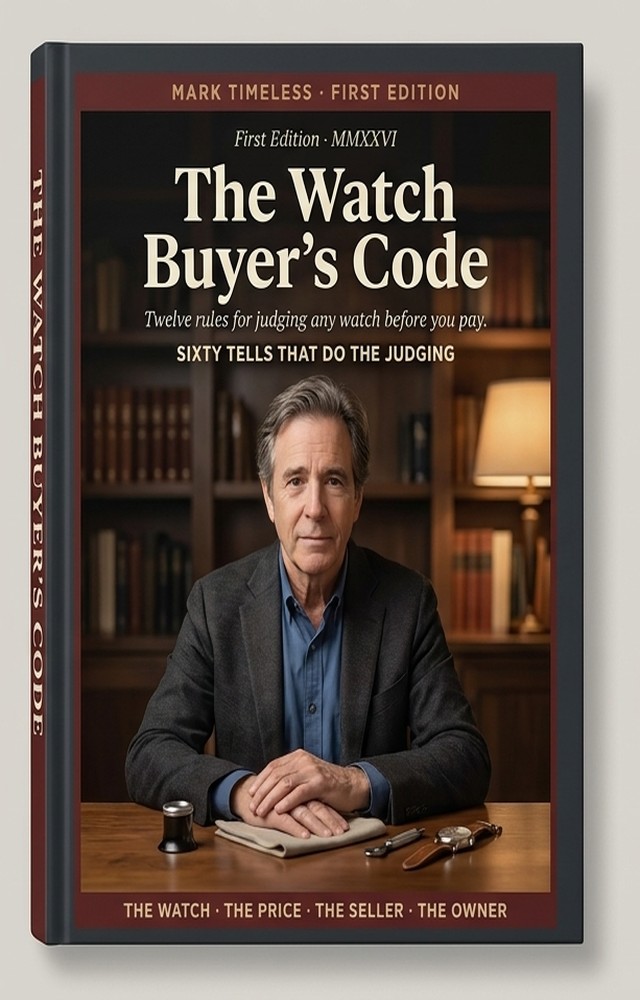
Twelve codes and sixty tells that let you judge any watch, at any price, from any seller — in about a minute, before the price gets a chance to talk you into anything.

“The best outcome this book can produce for you is not a better watch. It is the watch you did not buy.”
— Mark TimelessMost bad watch purchases are not caused by a lack of knowledge. They are caused by looking at the wrong thing first. Someone sees a photograph. They like the photograph. They look at the price, compare it against a vague internal sense of what that brand ought to cost, and if it feels good against that vague sense, they start hunting for reasons to say yes.
Everything after that point is rationalisation, and rationalisation is very good at its job.
I have been buying, selling, repairing badly, sending out to be repaired properly, and wearing wristwatches for a long time. I have been wrong expensively enough times to have learned something. Most of what is in this book I learned by paying for the lesson.
A few of the chapters started life as videos on the channel. All of them go further here than they ever did there, because a video has to stop and a book does not.
Nothing in here requires you to spend more money. Several of the codes will talk you out of a purchase, and that is the point.

Not five. Not twenty. Three — and they take about a minute between them. Here is what changes the moment you run them.
The watch, the price, the seller, the owner. Read it in any order you like — but if you have a purchase in front of you right now, start with the Triage and go to whichever code covers the thing that is worrying you.
“I asked a seller to name the movement and got three paragraphs that never answered the question. Six months ago I'd have bought it anyway. That one page paid for the book several times over.”
Ray D. · Ohio“The chapter on the cost of keeping it was the one that got me. I had never once added up a decade of servicing before deciding what I could afford. Completely changed what I was shopping for.”
Alan W. · Kent, UK“Printed the checklist and the ledger, put them in the drawer with the watches. My son used the checklist on his first proper buy and walked away from it. Best money I've spent on the hobby.”
Doug M. · Alberta
I have been buying, selling, repairing badly, sending out to be repaired properly, and wearing wristwatches for a long time — long enough to have been wrong expensively more than once, which turns out to be the only reliable way anyone learns this.
I make videos about vintage and pre-owned watches for people who like them and would rather not be taken for a ride buying one. No hype, no watch-of-the-year lists, no telling you what you ought to want. Just the boring questions, asked in the right order.
This book is the long version of the thing I keep saying on the channel: almost nobody is ever taught any of this, and the industry has never had a reason to teach it. So here it is, written down, with the diagrams I could never fit into a video.
Twelve rules for judging any watch before you pay. Sixty tells that do the judging.
No — and that is the first thing the book says about itself. It is not a coffee-table book and it is not a list of watches I think you should want; there are enough of those. It is a method for looking at a watch, any watch, and working out what it is, what it is worth, and what it will cost you to live with. Several of the codes will talk you out of a purchase, and that is the point.

A few of the chapters started life as videos on the channel. All of them go further here than they ever did there, because a video has to stop and a book does not. The videos give you one watch and one story at a time; the book gives you the order to check things in, the sixty tells written down where you can carry them, and the workbook pages — the checklist and the ledger — that only work on paper.
Because the book argues against spending money you did not need to spend, and it would be a strange thing to price it like a luxury. $27 is a launch price against $47. If the Triage in the opening chapter stops one bad purchase — and it is designed to stop them in about a minute — it has paid for itself many times over.
No. The book assumes you know nothing and explains the movement names, the case terms and the jargon as it goes; there is a plain glossary at the back for anything that slips through. It works just as well if you have been collecting for years — the difference is you will recognise your own expensive lessons in it.
No. It is educational, and it says so plainly: nobody knows what any watch will be worth in ten years. When the book talks about value it means the money you are likely to get back if you sell, which is a very different thing from a return. Buy a watch because you want to wear it. It is also not a substitute for professional authentication — for a high-value purchase, get an independent opinion from a qualified watchmaker.
A 134-page illustrated PDF, delivered instantly through Gumroad the moment you check out. It reads on a phone, a tablet, a laptop or an e-reader, and the workbook pages are laid out to be printed. There is no shipping and nothing to wait for — the download link is on the confirmation page and in your email.

Twelve codes and sixty tells, for $27 instead of $47. If the Sixty-Second Triage stops one purchase you would have regretted, it has already paid for itself — and talking you out of the wrong watch is the job it was written to do.
Get The Watch Buyer’s Code — $47 $27